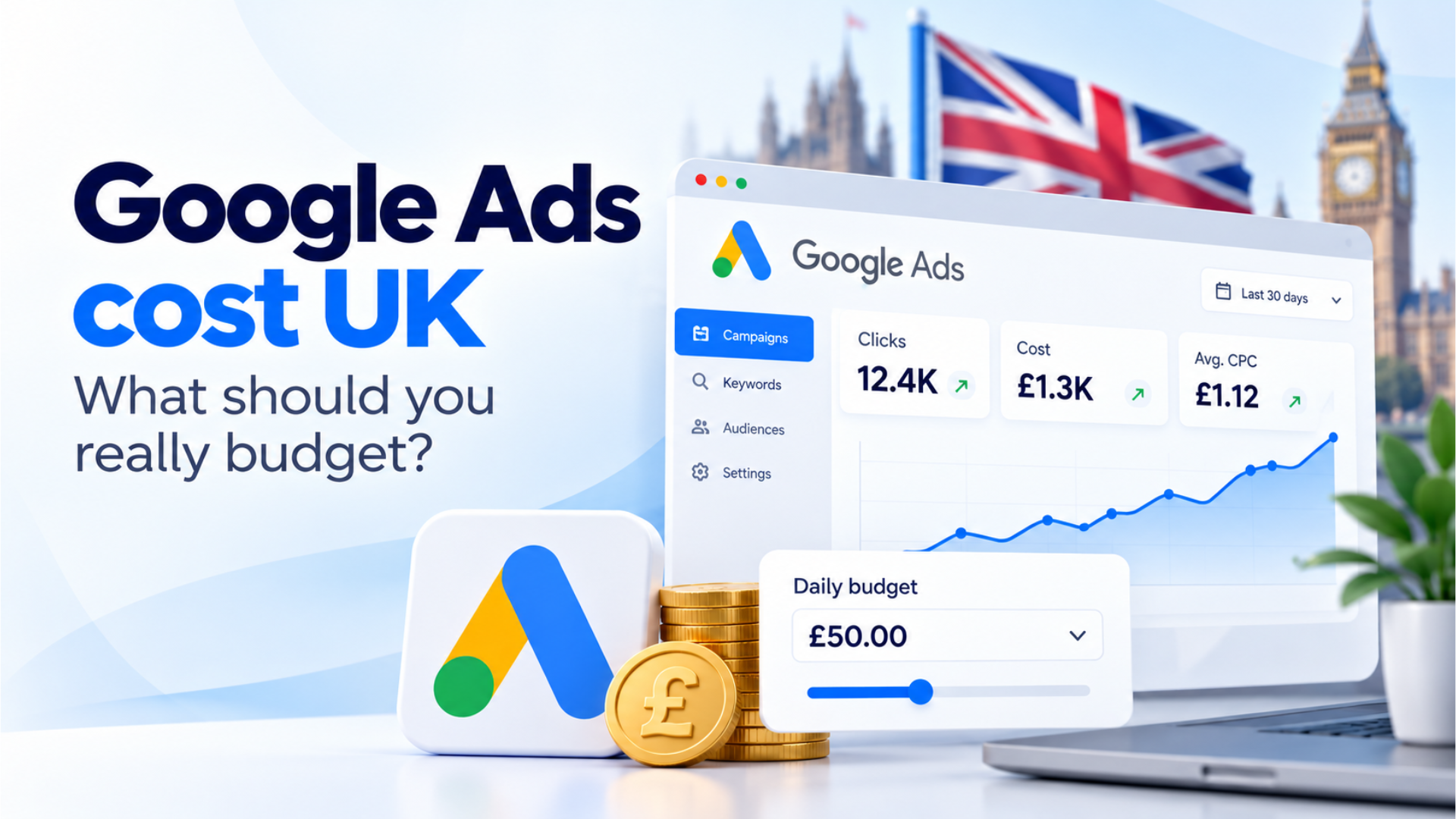
Google Ads cost in the UK has no fixed price. You choose how much you are willing to spend, while the actual amount you pay depends on factors such as your industry, keywords, location, competition, bidding strategy, ad quality, and campaign goals.
For Google Search campaigns, many current UK benchmark sources place typical cost-per-click figures somewhere around the low-single-digit pounds, but this average can be misleading. Retail clicks may cost less than £1 in some campaigns, while legal, financial, B2B, healthcare, and high-intent local-service searches can cost several pounds or considerably more per click.
The better way to plan a Google Ads budget is to work backwards from what a customer is worth, how many leads you need, and what you can afford to pay to acquire one.
How much does Google Ads cost in the UK?
There is no minimum fixed Google Ads cost imposed as a standard package price. Advertisers control their campaign budgets, and Google uses those budgets within its advertising auction.
Google explains that advertisers set an average daily budget for each campaign. For most campaigns, the monthly spending limit is calculated using the average daily budget multiplied by 30.4, although spend can fluctuate between individual days.
A useful way to think about Google Ads cost is to separate it into three possible expenses:
- Ad spend paid directly to Google.
- Management fees if an agency or freelancer manages the campaigns.
- Supporting costs such as landing-page development, conversion tracking, creative production, or call tracking.
The first cost is unavoidable if you want to advertise. The other two depend on how your campaigns are set up and managed.
What is the average Google Ads CPC in the UK?
There is no official Google-published figure for the average cost per click across every UK industry.
Independent UK benchmark studies currently vary because they analyse different advertisers, industries, time periods, and account samples. Some 2026 UK datasets place broad Search CPC averages around £1.50 to £2.50, while individual industries can sit well above or below that range.
This is why an overall average should only be used as an orientation point. A solicitor bidding on a commercially valuable legal query should not build a campaign budget around the same CPC assumption as an online clothing retailer.
Indicative Google Ads CPC ranges by industry
The following ranges are based on current published UK benchmark data and should be treated as planning estimates rather than guaranteed prices.
| Industry | Indicative UK Search CPC range |
|---|---|
| Legal services | £4.50–£15+ |
| Financial services | £3–£10+ |
| B2B and SaaS | £2–£6+ |
| Home services | £1.50–£5.50+ |
| Healthcare and dental | £1.50–£5+ |
| Education and training | £1–£4.50 |
| Recruitment | £1–£4 |
| Travel and hospitality | £0.80–£3.50 |
| Retail and e-commerce | £0.40–£2+ |
These ranges come from published UK market research covering Google Search campaigns. Your actual CPC can fall outside them because search terms, geography, ad quality, competition, device, bidding strategy, and customer intent all influence the auction.
The most reliable estimate for your own business will come from researching your actual keywords in Google Keyword Planner rather than relying solely on industry averages. Google says Keyword Planner can provide keyword-specific traffic and cost estimates to help advertisers plan bids and budgets.
How does Google Ads pricing work?
Google Ads does not operate like buying a fixed advertising slot for a fixed price. For Search campaigns, advertisers compete in an auction when an eligible search takes place. Google considers several factors when determining whether an ad appears, where it appears, and what the advertiser ultimately pays.
These factors include:
- Your bid
- Auction competition
- Expected click-through rate
- Ad relevance
- Landing-page experience
- Search context
- Expected impact of ad assets
Google refers to the final amount charged for a click as your actual CPC. Your actual CPC is often lower than your maximum CPC bid because Google generally charges what is necessary to clear the relevant Ad Rank thresholds and compete with the advertiser below you. This explains why two businesses targeting similar keywords can pay different amounts for clicks.
The business bidding the most money does not automatically receive the best outcome. Relevance, landing-page experience, competition, and other auction-time signals also matter.
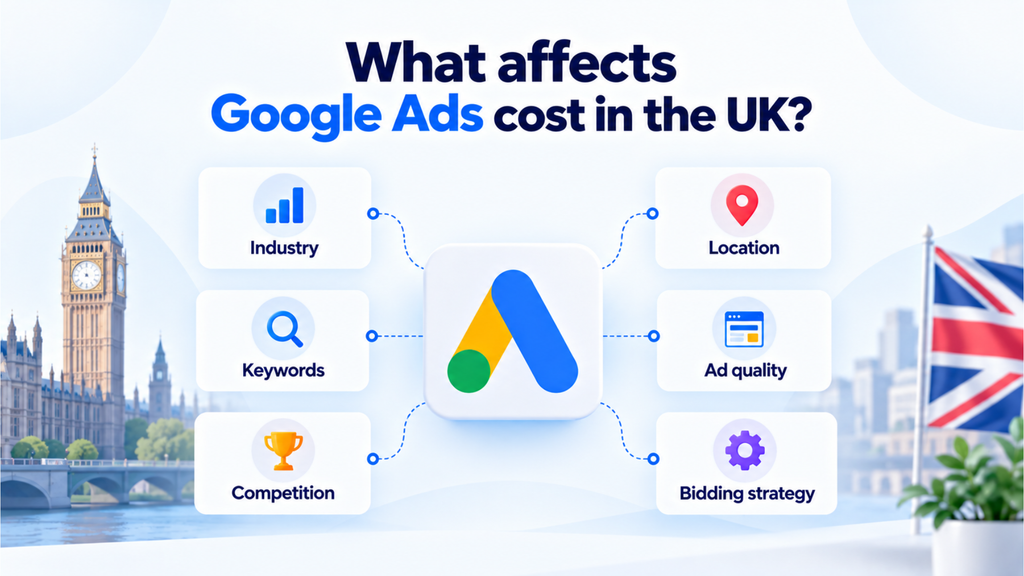
What affects Google Ads costs in the UK?
Google Ads costs can change significantly even between two campaigns advertising similar services.
Several factors have a particularly strong influence.
Keyword competition
High-value commercial keywords usually attract more advertisers.
Imagine two searches:
“how to fix leaking tap” and: “emergency plumber near me”
The second search shows much stronger immediate buying intent. Plumbing companies may therefore be willing to bid considerably more for that visitor. Google’s own UK guidance confirms that highly transactional searches generally face stronger competition and can carry higher costs than informational queries.
Industry
Industries where one customer can be worth thousands of pounds can support higher advertising costs. Legal services, financial products, specialist B2B services, healthcare, property-related services, and expensive home services frequently have more competitive auctions because a successful customer acquisition can generate substantial revenue.
Lower-value retail clicks may cost less, but those businesses often need significantly more sales volume. CPC should therefore never be evaluated without considering customer value.
Location
Advertising in London is not necessarily priced the same as advertising in a smaller UK town. Competition can be greater in densely populated areas where more businesses are bidding for the same customers.
Google specifically identifies geographic targeting and competitive density as factors that can influence advertising costs. Local businesses should therefore examine cost forecasts for the exact locations they intend to target.
Search intent
Commercial intent affects what advertisers are willing to pay. A user searching: “best mortgage broker London” may be significantly more commercially valuable than someone searching:
“what does a mortgage broker do?”
Both keywords relate to the same service, but they represent different positions in the customer journey. Your highest-volume keywords are not automatically your most profitable keywords.
Ad and landing-page relevance
Sending every keyword to the homepage is rarely an effective strategy. A person searching for a specific service should ideally see an ad and landing page closely related to that service.
Google’s auction considers signals including expected click-through rate, ad relevance, and landing-page experience when determining Ad Rank. Better relevance therefore has implications beyond user experience. It can affect how effectively your advertising budget competes in the auction.
Bidding strategy
The bidding strategy you choose determines what Google is trying to optimize. Depending on the campaign and objective, strategies may focus on clicks, conversions, conversion value, target CPA, or target ROAS.
Google notes that a strategy such as Maximise Clicks may optimise differently from a conversion-focused strategy. A higher CPC is therefore not necessarily negative if those clicks generate substantially more valuable customers.
Seasonality
Advertising costs are not static throughout the year. Competition can increase when demand is high, particularly around Christmas, Black Friday, school intake periods, travel seasons, tax deadlines, or industry-specific buying cycles.
More advertisers competing for the same valuable searches can put upward pressure on costs. Seasonality should therefore be considered when comparing one month’s CPC with another.
How much should a small business spend on Google Ads in the UK?
There is no single monthly Google Ads budget that is right for every small business. A £500 monthly budget could generate useful data for a tightly targeted niche business with relatively inexpensive clicks. The same £500 could be exhausted quickly in a highly competitive legal or financial campaign.
The question should be:
Can my budget purchase enough relevant traffic to generate meaningful conversion data?
Consider a business expecting an average CPC of £3.
A £300 media budget could theoretically purchase around 100 clicks before other variables are considered. If the landing page converted 5% of those visitors into enquiries, that would produce approximately five leads.
Whether that outcome is attractive depends entirely on what those leads are worth and how many become paying customers.
Why very small Google Ads budgets can be difficult
Google will allow businesses to choose relatively small budgets, but technically being able to run a campaign is different from having enough budget to evaluate it properly. Suppose a competitive campaign receives only a handful of clicks per week.
It may take a long time to collect enough information to determine:
- Which keywords convert
- Which search terms waste money
- Which ads perform best
- Which devices generate enquiries
- Which locations produce customers
- Which landing pages convert
- Which audience segments are valuable
A tightly focused campaign can sometimes work with a modest budget.
However, spreading a small budget across ten services, several cities, and dozens of keywords usually makes useful optimisation harder.
How to calculate a realistic Google Ads budget
Instead of starting with an arbitrary figure such as £500 or £1,000, work backwards from your business economics.
Start with these four numbers:
- Average customer value
- Profit margin
- Lead-to-customer conversion rate
- Target customer acquisition cost
Imagine a service business where the average customer generates £2,000 in revenue. If 25% of qualified enquiries become customers, the business needs roughly four qualified leads to acquire one customer.
Now assume the business is comfortable spending £300 to acquire that customer.
Its approximate target cost per qualified lead becomes:
£300 ÷ 4 = £75 per lead
If the company wants ten additional customers per month, it would need approximately forty qualified leads.
At a target CPL of £75:
40 × £75 = £3,000
That gives the business a much more defensible starting advertising budget than simply copying what another company spends. These numbers are only an example. Your own margins, customer value, closing rate, repeat purchases, and lifetime value should determine what you can profitably spend.
Google Ads daily budget vs monthly budget
Google Ads primarily asks advertisers to set an average daily budget at campaign level. Your spending does not necessarily equal that amount every day.
Google can spend more than the average daily budget on days where it expects greater opportunities and less on quieter days. For most campaigns, Google’s daily spending limit can reach two times the average daily budget, while the standard monthly spending limit is generally the daily budget multiplied by 30.4.
For example, if you want approximately £1,000 available for a campaign across an average month, your campaign budgeting should be planned around Google’s 30.4-day calculation rather than simply dividing by 30.
This distinction is important when reviewing daily spend. Seeing spend above your average daily figure on an individual day does not automatically mean Google has ignored your monthly campaign budget.
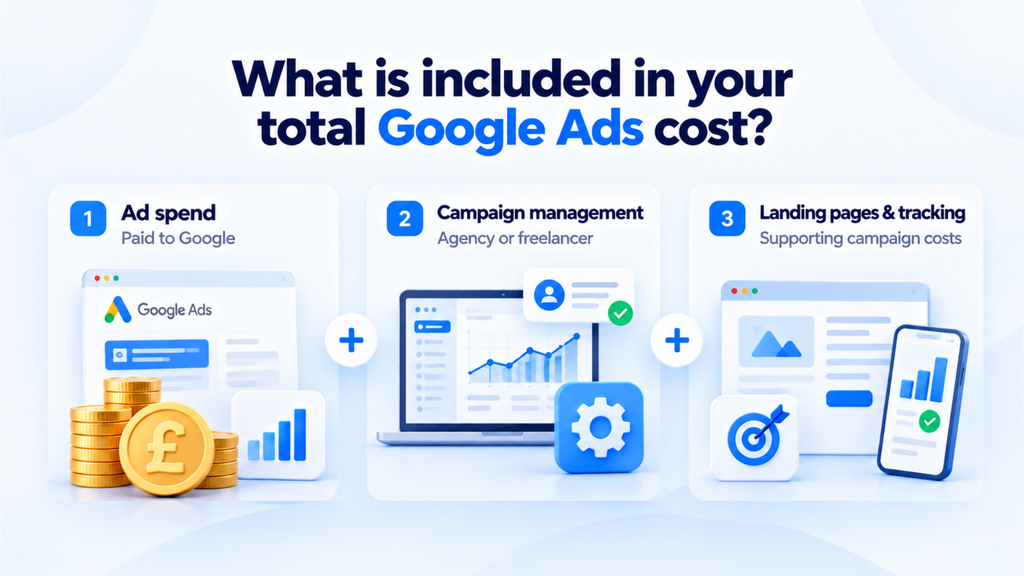
What is included in your total Google Ads cost?
Businesses often compare agencies based only on media spend.
hat can hide other costs required to run a profitable campaign.
Google Ads spend
This is the media budget paid to Google. If your monthly ad budget is £2,000, that £2,000 is used by the advertising platform to compete for traffic.
It is separate from an agency’s management fee unless your agreement explicitly states otherwise.
Campaign management
Businesses that do not manage campaigns internally may pay a freelancer, consultant, or PPC agency.
Common pricing structures include:
- Fixed monthly fee
- Percentage of ad spend
- Tiered fee based on spend
- Hybrid fixed fee plus percentage
- Project-based setup fee
Published UK pricing research shows considerable variation, with small-account management fees ranging from a few hundred pounds per month to substantially more for larger or more complex accounts. Do not compare fees without comparing scope.
A £300 management service and a £1,500 service may include very different levels of strategy, tracking, landing-page testing, reporting, feed management, creative work, and optimisation.
Landing pages
Paying for high-quality traffic and sending it to a weak page can make an otherwise good Google Ads campaign unprofitable.
A campaign may therefore require investment in:
- Landing-page design
- Copywriting
- Forms
- Mobile optimisation
- Page speed
- A/B testing
- Conversion optimisation
These costs are not payments to Google, but they influence the return generated by your Google Ads investment.
Conversion tracking
Businesses should understand what happens after someone clicks an ad.
Relevant conversion actions might include:
- Purchases
- Form submissions
- Calls
- Quote requests
- Bookings
- Trial registrations
- Qualified leads
Google’s UK campaign setup guidance recommends establishing conversion tracking when campaigns are optimised for online conversions. Without accurate tracking, a campaign can generate clicks without giving the business reliable information about whether those clicks produced revenue.
How different Google Ads campaign types affect cost
Google Ads is much broader than standard text-based Search campaigns. Your costs can change depending on the campaign type and advertising objective.
Search campaigns
Search campaigns capture users actively searching for relevant products or services. Because the intent can be extremely strong, competitive commercial Search keywords often carry higher CPCs than lower-intent advertising environments. This is also where most discussions of Google’s UK CPC benchmarks are focused.
Shopping campaigns
Shopping ads are particularly relevant to e-commerce businesses. Instead of evaluating performance only through CPC, retailers should pay close attention to conversion value, revenue, product margin, and ROAS. A cheaper click is not necessarily better if it generates low-value sales.
Performance Max
Performance Max can serve ads across Google’s channels from a single campaign and uses automated optimisation to pursue the selected conversion goals.
Google recommends setting budgets around conversion economics rather than simply pursuing the cheapest possible clicks. Businesses using Performance Max therefore need reliable conversion tracking and useful conversion values where appropriate.
Display and video campaigns
Display and video campaigns often serve different purposes from high-intent Search advertising. They may be used for awareness, remarketing, consideration, or demand generation. Comparing their CPC directly with Search CPC can therefore be misleading because the user’s intent and the campaign objective may be completely different.
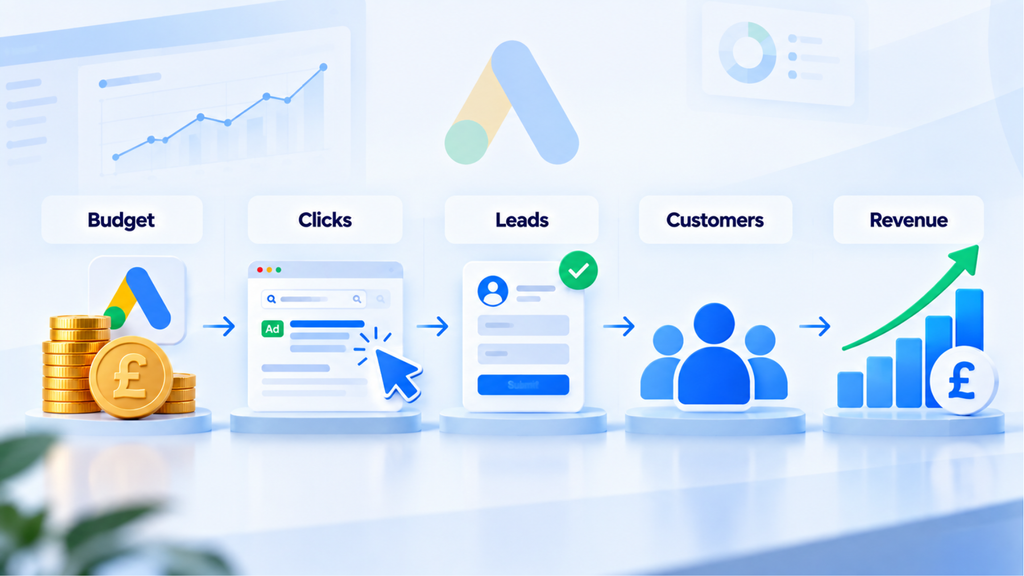
What matters more than cost per click?
CPC is useful, but it is not the metric that tells you whether Google Ads is profitable. Imagine two campaigns.
Campaign A
- CPC: £1
- 100 clicks: £100
- Conversions: 1
- Cost per conversion: £100
Campaign B
- CPC: £4
- 100 clicks: £400
- Conversions: 20
- Cost per conversion: £20
Campaign B has a CPC four times higher. Yet it produces customers or leads at one-fifth the acquisition cost.
This is why businesses should evaluate Google Ads using metrics such as:
- Conversion rate
- Cost per conversion
- Cost per qualified lead
- Customer acquisition cost
- Conversion value
- Revenue
- ROAS
- Profit
A low CPC campaign can waste money just as easily as an expensive one.
How can you reduce Google Ads costs?
The objective should not simply be to make every click cheaper. The better goal is to generate more valuable outcomes from the available budget.
Use negative keywords
Negative keywords can prevent Search ads appearing for queries that are irrelevant to the campaign. Google itself recommends negative keywords as one method of filtering unwanted traffic and reducing wasted spend.
Reviewing the actual search terms that triggered your ads can reveal irrelevant searches that should be excluded.
Focus on commercial intent
Do not automatically advertise on every keyword related to your industry. A keyword may generate a large amount of traffic without generating customers. Priorities terms that closely align with your offer, customer journey, location, and business objective.
Improve landing pages
Your advertising cost does not stop when the visitor clicks. A better landing page can allow the same traffic budget to generate more enquiries or sales.
Make sure the page:
- Matches the ad
- Loads quickly
- Works well on mobile
- Explains the offer clearly
- Provides strong trust signals
- Includes an obvious next action
- Removes unnecessary friction
Improving conversion rate is often more commercially valuable than reducing CPC.
Improve ad relevance
Create ads that closely match what the searcher is looking for. The keyword, ad messaging, offer, and landing page should feel connected rather than generic. Google includes ad relevance and landing-page experience among the factors used in its auction system.
Target locations carefully
A UK-wide campaign is unnecessary if you only serve clients within 20 miles of Manchester. Geographic targeting can stop budget being distributed into areas where you cannot realistically generate customers. Location performance should also be reviewed after enough data has accumulated.
Use ad scheduling where appropriate
Performance may vary by time and day. For certain businesses, leads arriving during business hours may be significantly more valuable because staff can respond immediately. Google allows advertisers to use scheduling and related controls to manage when campaigns run.
Measure qualified outcomes
Generating 100 form submissions means little if 90 are irrelevant. Where possible, connect advertising data with CRM or sales information so campaign decisions can be based on qualified leads and customers rather than raw conversion volume. This becomes increasingly important when using automated bidding.
Should you manage Google Ads yourself or hire an agency?
Managing your own campaigns removes an external management fee, but it does not make management free. Your time has a cost.
A business running campaigns internally still needs to handle:
- Keyword research
- Campaign structure
- Ad creation
- Conversion tracking
- Search-term analysis
- Negative keywords
- Bid strategy
- Budget allocation
- Landing pages
- Reporting
- Ongoing optimisation
DIY management can be perfectly reasonable for a small, straightforward campaign when the business owner understands the platform and has time to manage it. As account complexity and monthly spend increase, poor decisions can become increasingly expensive.
How much should you spend before deciding whether Google Ads works?
There is no universal test budget. A meaningful test needs enough traffic to evaluate whether the campaign can convert relevant visitors.
Suppose your expected CPC is £5 and you test with £100. That gives you approximately twenty clicks.
If your underlying conversion rate is around 5%, twenty clicks may generate only one conversion on average. A short test could therefore produce zero leads or two leads simply through normal variation, making it difficult to draw a strong conclusion.
A business paying £0.80 per click receives far more traffic from the same £100. This is why test budgets should be based on expected CPC, conversion rate, and the amount of data needed to make a decision.
Is Google Ads worth the cost for UK businesses?
Google Ads can be worth the cost when it generates customers at a level that makes commercial sense. The platform gives businesses the ability to capture people who are actively searching, but buying traffic does not guarantee profitability.
Google Ads is more likely to work when:
- There is existing search demand
- Your offer is competitive
- Customer value supports the CPC
- Your landing page converts
- Conversion tracking is reliable
- Campaign targeting is focused
- Leads are followed up effectively
- Performance is regularly optimised
It becomes harder to justify when margins are extremely small, conversion tracking is missing, the website performs poorly, or the business cannot afford enough relevant clicks to collect useful data.
Google Ads cost vs SEO cost
Google Ads and SEO use very different cost models. With Google Ads, businesses generally keep paying for media to maintain paid visibility.
SEO requires investment in strategy, content, technical work, and authority development, but organic clicks themselves are not purchased individually. This does not make SEO free or Google Ads expensive by definition. The channels solve different problems.
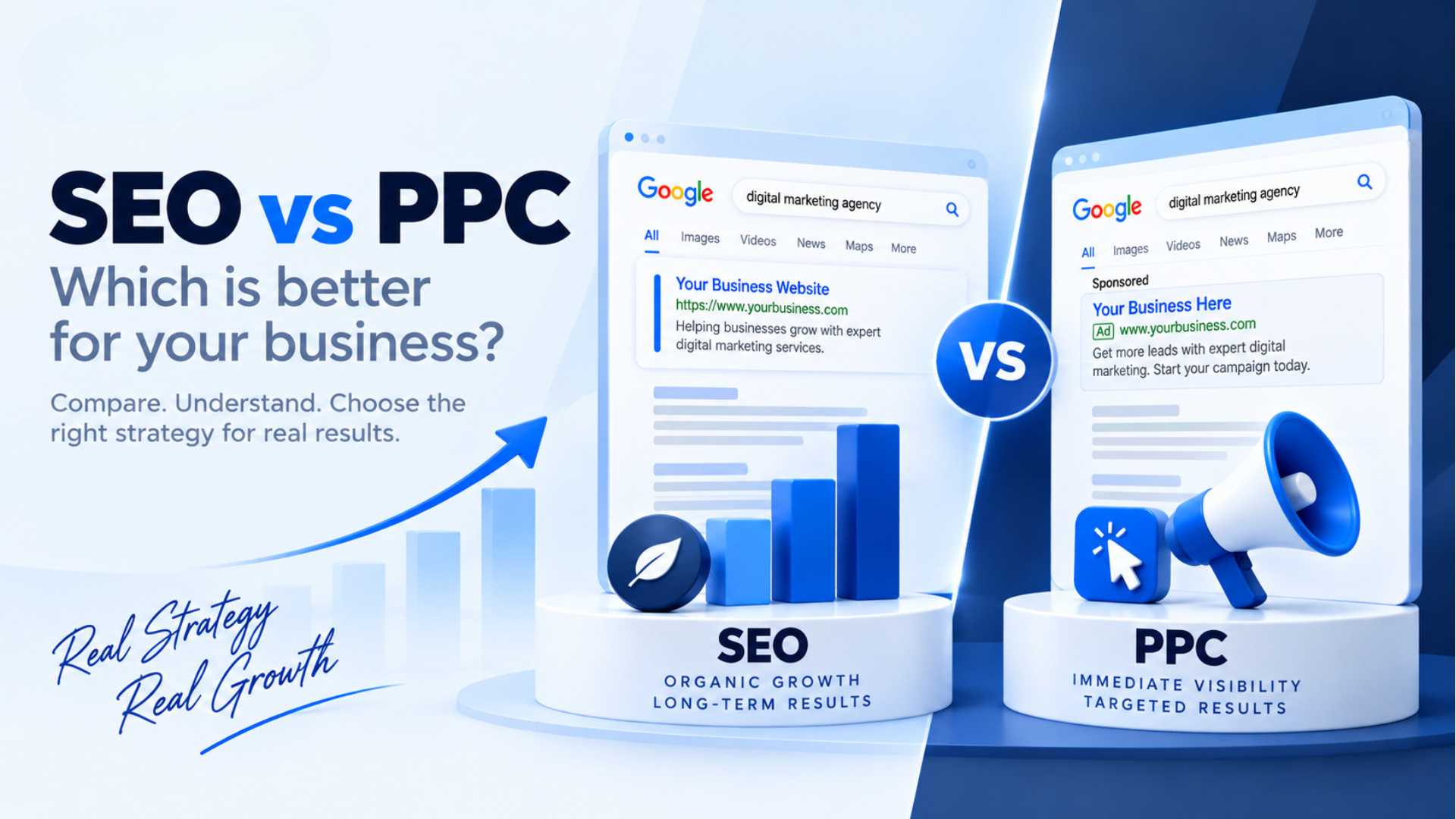
Google Ads can provide fast access to existing search demand, while SEO can build longer-term organic visibility. Businesses deciding between them should compare SEO vs PPC based on timeline, customer acquisition economics, search demand, and long-term growth objectives rather than CPC alone.
Common Google Ads budgeting mistakes
One of the biggest mistakes is choosing a budget simply because another company spends the same amount. Their industry, conversion rate, margins, CPC, customer value, and sales process may be completely different from yours.
Other common mistakes include:
- Spreading a small budget across too many campaigns
- Targeting overly broad keywords
- Ignoring negative keywords
- Optimising for clicks instead of customers
- Sending all ads to the homepage
- Running ads without conversion tracking
- Increasing budget before fixing poor conversion rates
- Comparing CPC without comparing lead quality
- Failing to account for management costs
- Treating one week of data as definitive
Your budget should support a measurable business objective rather than simply keeping ads running.
So, what is a realistic Google Ads budget in the UK?
There is no single correct number. For some tightly targeted small businesses, several hundred pounds per month may provide enough traffic to begin testing. Businesses competing across larger locations, multiple services, or high-value industries may need budgets in the thousands or tens of thousands of pounds.
Start with the economics. Estimate your likely CPC using Keyword Planner, determine how many clicks you may need to generate a conversion, calculate what a customer is worth, and decide how much you can profitably spend to acquire one.
Then build your budget from those numbers. The most useful answer to “How much does Google Ads cost in the UK?” is therefore not an industry average. It is the amount your business can invest while acquiring profitable customers at a sustainable cost.
Frequently asked questions
How much does Google Ads cost per click in the UK?
There is no fixed UK CPC. Current independent UK benchmark studies commonly place many Search campaigns around the low-single-digit pounds per click, but costs vary significantly by industry, keyword, location, intent, competition, and campaign quality. Legal, financial, B2B, and urgent service keywords can cost considerably more.
What is the minimum budget for Google Ads in the UK?
Google does not require every UK advertiser to use the same fixed monthly campaign budget. You control your average daily campaign budget. A commercially useful minimum depends on your expected CPC and how many clicks and conversions are required to collect enough data to evaluate the campaign.
Is £500 a month enough for Google Ads?
It can be enough for a narrowly targeted campaign in some markets, but £500 is not universally sufficient. If clicks cost £1, the budget buys much more traffic than it would in a market where clicks cost £8. Evaluate the budget against CPC, conversion rate, customer value, targeting area, and the number of services being promoted.
How much should a small UK business spend on Google Ads?
A small business should work backwards from its target cost per customer rather than copying a generic monthly budget. Estimate expected CPC, conversion rate, customer value, and the number of customers required. Google Keyword Planner can help estimate click costs for the specific keywords and locations being targeted.
Does Google Ads charge every day?
Google Ads uses average daily campaign budgets, but actual daily spend can fluctuate. For most campaigns, Google states that spend can reach up to twice the average daily budget on an individual day, while the standard monthly spending limit is generally the daily budget multiplied by 30.4.