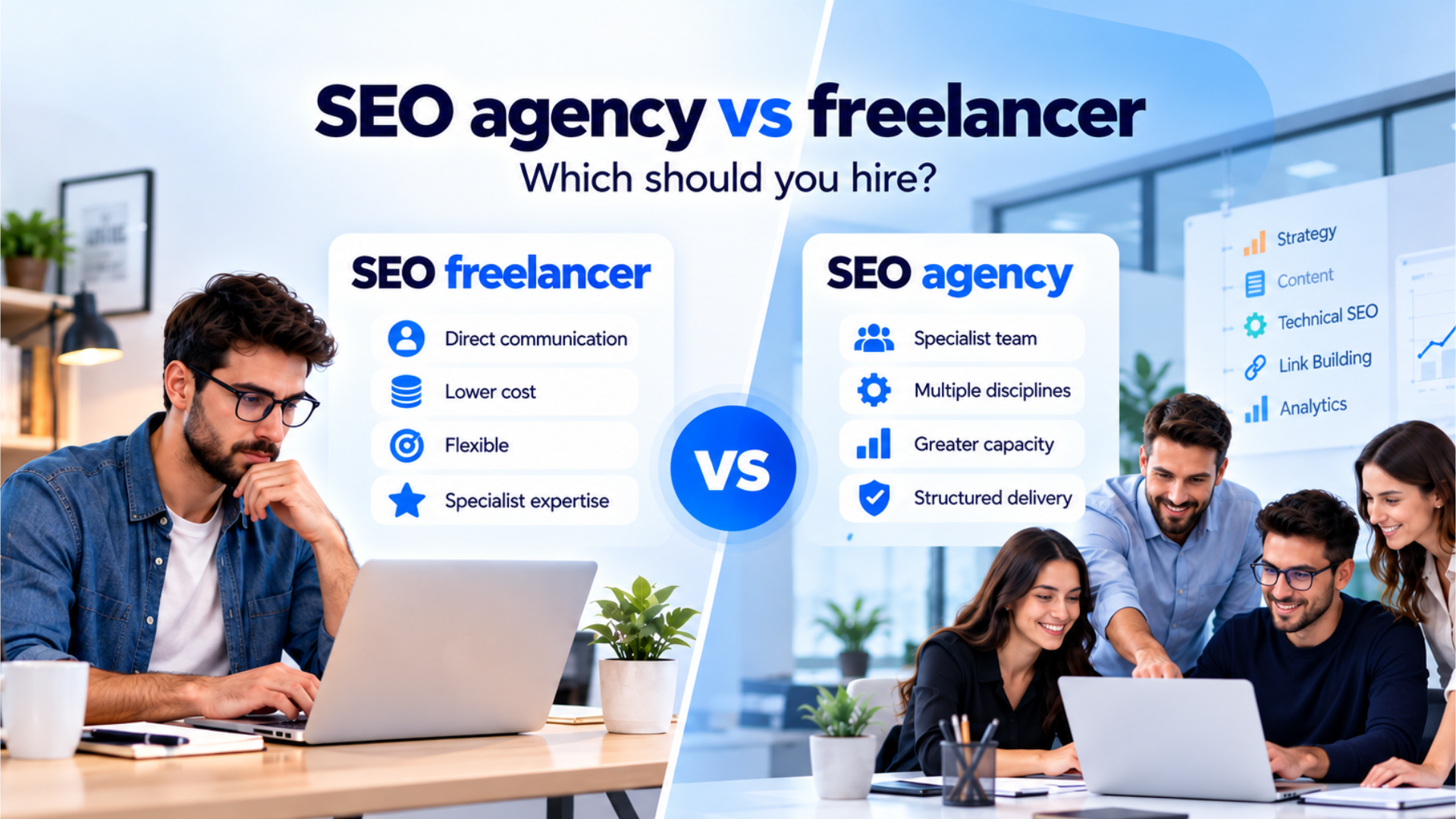
Choosing between an SEO agency vs freelancer is less about deciding which one is universally better and more about finding the delivery model that fits your business. A freelancer can offer direct access, specialist expertise, flexibility, and lower overheads. An agency can provide a broader team, greater capacity, structured processes, and continuity across multiple SEO disciplines.
The right choice depends on your budget, website complexity, internal resources, growth targets, and how much SEO work needs to happen at the same time. A strong freelancer can outperform a weak agency, while an experienced agency can handle a scale of work that one person may simply not have the capacity to deliver.
This guide compares both options across cost, expertise, communication, accountability, scalability, risk, and long-term value so you can make a more informed decision.
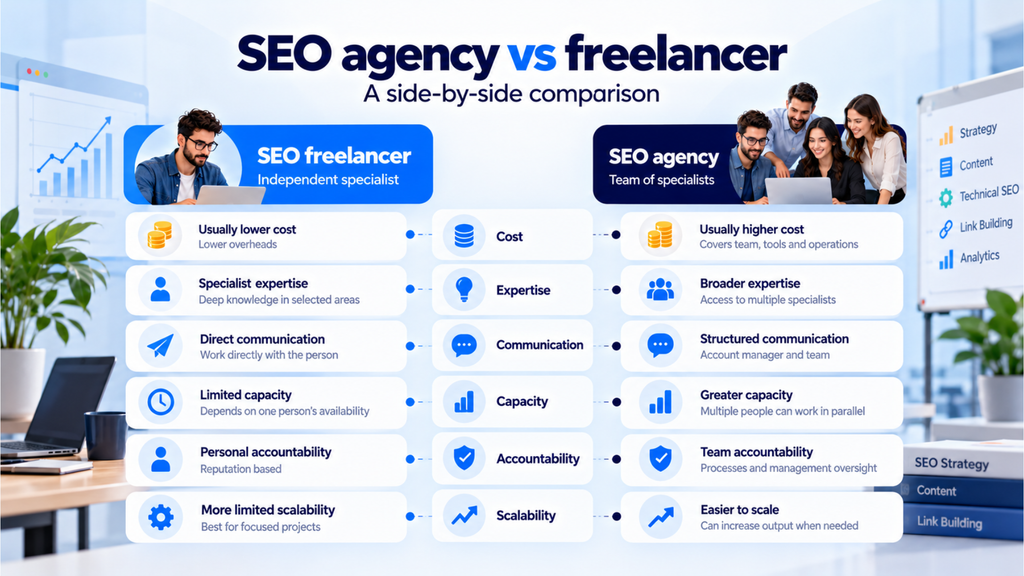
SEO agency vs freelancer: What is the difference?
An SEO freelancer is an independent specialist who typically works directly with clients and personally handles most or all of the agreed SEO work. Depending on their expertise, they may focus on technical SEO, strategy, content, link acquisition, local SEO, e-commerce SEO, or a combination of several areas.
An SEO agency operates as a business with multiple people who may cover different parts of the campaign. Your account could involve a strategist, technical SEO specialist, content writer, digital PR specialist, developer, and account manager. The key difference is therefore not simply company size.
It is how expertise, capacity, communication, and responsibility are organised.
| Factor | SEO freelancer | SEO agency |
|---|---|---|
| Main contact | Usually the person doing the work | Often an account manager or strategist |
| Expertise | Deep knowledge in selected areas | Broader access to multiple specialists |
| Capacity | Limited by one person’s availability | Can distribute work across a team |
| Cost structure | Usually lower overhead | Usually higher overhead |
| Communication | Often direct and fast | More structured |
| Scalability | More limited | Easier to scale |
| Continuity | Dependent on one person | Team can provide cover |
| Flexibility | Often high | Depends on agency processes |
| Best fit | Focused projects and smaller scopes | Larger or multi-discipline campaigns |
Current UK comparison pages broadly describe the same structural difference: freelancers tend to offer direct access and lower costs, while agencies provide broader capacity and team coverage. Neither model is inherently better for every company.
What does an SEO freelancer actually do?
A freelancer can provide many of the same core SEO services as an agency.
Depending on their experience, that might include:
- SEO strategy
- Keyword research
- Technical SEO audits
- On-page optimisation
- Content briefs
- SEO content writing
- Internal linking
- Competitor research
- Local SEO
- E-commerce SEO
- Link-building strategy
- Digital PR support
- Google Search Console analysis
- Reporting and measurement
Some freelancers specialize very narrowly. For example, a technical SEO consultant may be excellent at crawling, indexing, migrations, JavaScript SEO, and site architecture but may not write content or manage digital PR. Others operate more like independent consultants and manage a broader SEO programme themselves.
That distinction matters when comparing candidates. You are not really comparing “freelancer” with “agency”. You are comparing the specific capabilities of one provider with the specific capabilities of another.
What does an SEO agency do?
A specialist SEO agency usually combines several capabilities under one service structure. A campaign might involve one person defining strategy while others handle technical fixes, content, reporting, digital PR, outreach, analytics, or development support.
Google itself describes professional SEO work as potentially covering site structure, technical advice, content development, keyword research, market expertise, and other areas. The agency advantage becomes more noticeable when several of those disciplines need to operate simultaneously.
For example, an e-commerce website might need:
- Technical crawl analysis
- Product and category optimisation
- Content production
- Structured data review
- Internal-link restructuring
- Link acquisition
- Analytics
- Developer coordination
One experienced freelancer may be capable of planning all of that, but delivering every workstream at the same time can become a capacity problem.
SEO freelancer vs agency cost
Freelancers usually cost less than agencies because their operating structure is simpler. An independent consultant generally does not have to fund account-management teams, sales departments, multiple salaries, office costs, or large operational systems. An agency’s fee covers not only SEO labour but also the infrastructure required to deliver and manage the service.
Current UK comparison pages commonly place freelance SEO retainers below agency retainers, although published ranges vary considerably according to experience, campaign scope, market competition, and provider size. One current UK comparison, for example, places freelance retainers around £500–£2,500 per month and agencies around £1,500–£8,000+, but those figures should be treated as market examples rather than standard prices.
If pricing is a major part of your decision, our detailed guide to SEO cost in the UK explains the factors that influence SEO pricing in much more detail.
Cheaper does not automatically mean better value
A £600 freelancer who spends enough time understanding your business may provide significantly more value than a £2,000 agency package built around generic deliverables. The opposite can also be true.
A £1,500 freelancer may struggle to deliver technical SEO, content, outreach, design coordination, and reporting simultaneously, while an agency with several specialists may be able to deploy the budget more effectively across those areas.
The meaningful question is therefore not: Which option has the lowest monthly fee? It is: What expertise, time, deliverables, and outcomes am I receiving for that fee?
Who actually works on your website?
This is one of the most important questions to ask before hiring either option. With a freelancer, the person you interview is usually the person who will analyze your website, build the strategy, attend meetings, and complete the work.
That creates a simple relationship. If you hire an experienced senior consultant, you generally receive direct access to that person’s judgement and expertise throughout the project.
An agency can work differently. The person leading the sales or discovery call may not be the person completing your technical audit or optimizing your pages. Work may be distributed between strategists, account managers, junior SEOs, writers, outreach teams, and technical specialists.
That is not automatically a disadvantage. In fact, specialization is one of the main reasons to hire an agency.
But you should ask:
- Who will actually manage my SEO?
- Who will complete the technical work?
- What experience does that person have?
- Will I have direct access to specialists?
- How many accounts does my main contact manage?
- Which tasks are completed internally?
- Is any work outsourced?
The answers often reveal more than the agency’s homepage does.
SEO agency vs freelancer for expertise
Freelancers can offer extremely deep expertise. Someone who has spent ten years focused on technical SEO, for example, may know considerably more about complex migrations or JavaScript indexing than a general SEO agency.
The limitation is breadth. One person is unlikely to be equally strong at technical SEO, content strategy, writing, digital PR, link acquisition, local SEO, analytics, CRO, development, and design.
An agency can solve that through specialist coverage. Instead of expecting one person to handle everything, different experts can work on the parts they understand best.
When specialist depth matters more
A freelancer may be particularly effective when you already know the exact problem you need solved.
Examples include:
- Technical SEO audit
- Website migration
- Keyword strategy
- Content planning
- Local SEO
- Google Search Console analysis
- Internal-link restructuring
- SEO training
- SEO consultancy
You may not need an entire team for a narrowly defined problem.
When breadth matters more
An agency becomes more attractive when SEO requires several workstreams to happen together.
For example:
- Technical SEO
- Ongoing content
- Digital PR
- Link acquisition
- Local SEO
- Conversion optimisation
- Development support
- Reporting
A coordinated team can handle parallel tasks without one person’s calendar becoming the main constraint.
Which option gives you better communication?
Freelancers usually offer more direct communication. You ask the person doing the work a question and receive an answer from the same person. There is less risk of technical information being simplified or altered as it moves between specialists and an account manager.
That can make decisions faster. Agencies often introduce more structure.
You may have:
- Scheduled review meetings
- Project-management systems
- Monthly reporting
- Account-management support
- Defined escalation processes
- Formal approval workflows
For some companies, that structure is valuable. A marketing manager overseeing several suppliers may prefer an agency with predictable reporting and project management. A founder who wants to message the SEO specialist directly may prefer a freelancer.
Neither communication model is automatically better. The important question is which one fits the way your team works.
Which option provides better accountability?
Accountability can exist in both models, but it looks different.
A freelancer’s reputation is closely connected to their personal name. Their future referrals, reviews, and repeat business often depend directly on each client relationship. An agency usually creates accountability through systems.
This can include:
- Contracts
- Defined scopes
- Project managers
- Reporting schedules
- Management oversight
- Service-level processes
- Team reviews
Larger organizations may prefer formal accountability because multiple stakeholders need visibility into what is happening. Smaller companies may value the personal accountability of dealing directly with one specialist.
What matters most is transparency. Your SEO provider should be able to explain what they are doing, why they are doing it, what has changed, and how progress is being measured.
Google’s own guidance specifically recommends asking potential SEOs about expected results, timeframes, measurement, experience, communication, and whether they will explain the changes they make.
Which option scales more easily?
Agencies generally have a structural advantage when the workload increases.
If your campaign suddenly requires:
- 20 new landing pages
- A technical migration
- Digital PR
- Content refreshing
- Backlink outreach
- International SEO
- Additional reporting
an agency can potentially assign more people.
A freelancer cannot simply create more working hours. They may bring in subcontractors or trusted partners, but at that point the delivery model begins to resemble a small distributed agency.
This does not matter if your scope is stable. A local company that needs several pages improved, ongoing optimization, and monthly strategy support may never require a large team. A national e-commerce website with thousands of URLs might.
What happens if your SEO provider becomes unavailable?
This is one area where the difference between the two models is very practical. If your freelancer becomes ill, takes a holiday, or reaches capacity, some work may pause.
An agency has more potential redundancy because another team member may be able to cover urgent work. That matters more in some situations than others.
A two-week slowdown on a small local campaign might have little impact. A problem during a large site migration or international launch could be much more serious.
Ask both agencies and freelancers how they handle:
- Holidays
- Illness
- Emergency technical issues
- Urgent website changes
- Knowledge transfer
- Access credentials
- Documentation
Business continuity should be part of the buying decision when SEO is an important acquisition channel.
Which is better for a small business?
A freelancer can make a lot of sense for a small business when the website is relatively straightforward and the scope is clearly defined. You may get direct access to an experienced specialist without paying for a larger agency structure.
A freelancer may be especially suitable when:
- Budget is limited
- You need one main SEO specialist
- Your website is small or medium-sized
- Your market is not extremely complex
- You have internal writers or developers
- Communication speed matters
- The work is focused
However, “small business” does not always mean “simple SEO”.
A small e-commerce company might still have thousands of products, international targeting, JavaScript issues, content requirements, and complex tracking. Choose based on complexity, not employee count alone.
Which is better for a growing company?
As a company grows, SEO often becomes more operationally complicated. More products create more pages. More locations create local SEO requirements. New markets create international considerations. Larger content programmes require writers, editors, designers, and developers to coordinate.
This is where an agency can become more practical. A growing company may benefit from having access to several specialists without recruiting them individually.
The agency can also provide additional capacity when priorities change. That said, a senior SEO freelancer working closely with a strong internal marketing team can still be an excellent model. If the company already has developers, writers, designers, and PR support, one experienced SEO strategist may be all that is missing.
Which option is better for a new website?
New websites usually need strategy and prioritisation more than a huge volume of random SEO tasks.
The early work may include:
- Search-demand research
- Site architecture
- Keyword mapping
- Technical setup
- Service-page planning
- Content strategy
- Internal linking
- Analytics
- Search Console configuration
An experienced freelancer can handle this effectively if the scope is manageable. An agency may be more appropriate if the new website is large, being launched across several markets, or requires substantial technical, content, and development coordination.
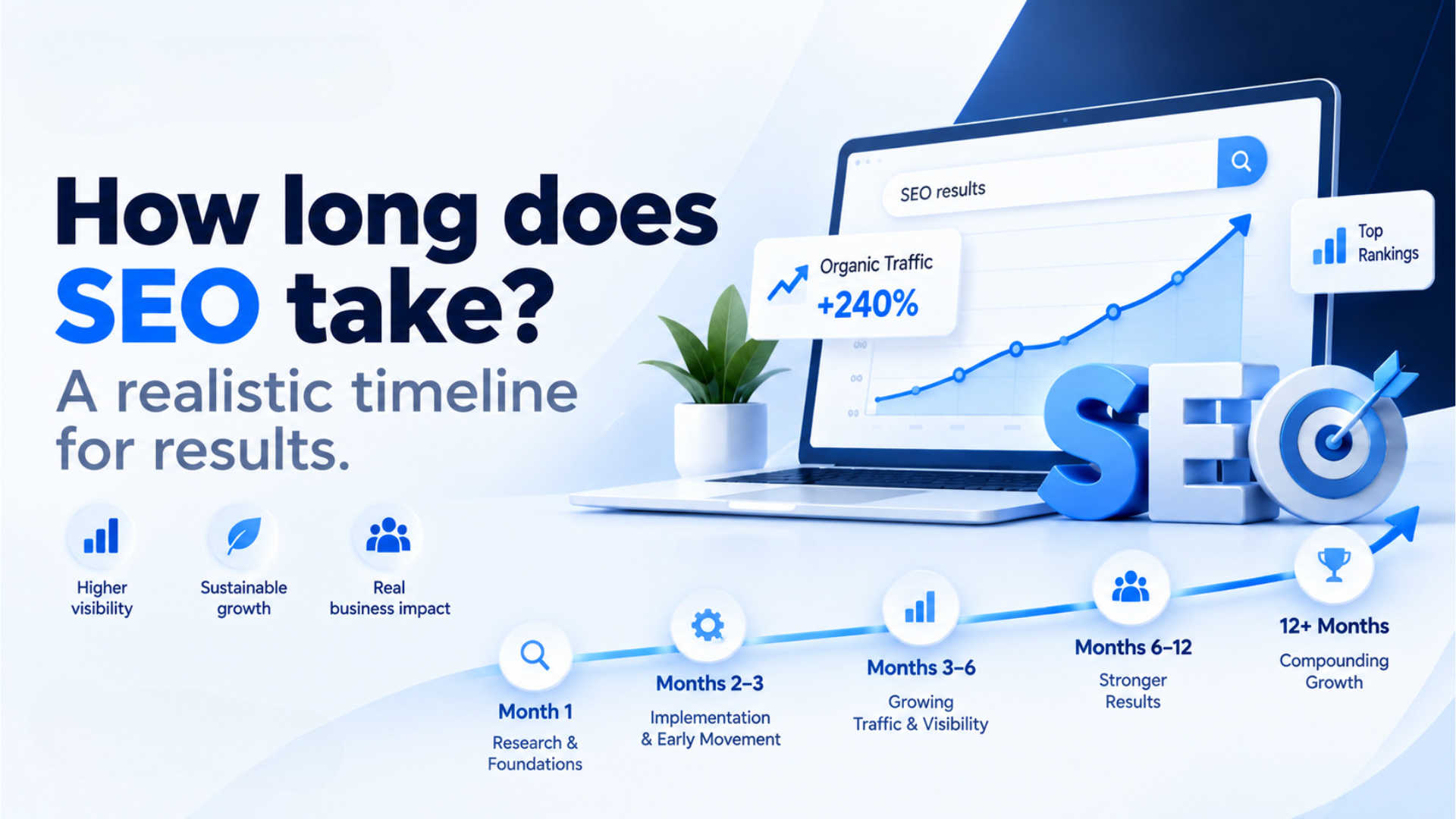
Remember that SEO is not immediate regardless of which provider you hire. Our guide on how long SEO takes explains why meaningful search visibility usually develops progressively rather than appearing as soon as work begins.
Google also notes that some SEO changes can be reflected quickly while others can take several months, and not every change will produce a noticeable search impact.
Agency vs freelancer for technical SEO
Technical SEO is a good example of why the provider’s actual experience matters more than their business type. A skilled technical SEO freelancer may be significantly more capable than an agency whose main strength is content marketing.
At the same time, an agency with technical specialists and developers may be better equipped to implement complex recommendations. Ask about experience with problems relevant to your website.
That might include:
- Crawling and indexing
- Canonicalisation
- JavaScript
- Rendering
- International SEO
- Structured data
- Site migrations
- Faceted navigation
- Duplicate content
- Log-file analysis
- Page speed
- Large e-commerce websites
Do not assume that “full-service SEO agency” automatically means deep technical capability.
Agency vs freelancer for content SEO
Content-heavy SEO campaigns benefit from consistent production. A freelancer can create the strategy and briefs, but if the campaign needs ten or twenty pieces of content every month, they may need additional writers.
An agency may already have a content operation. This can make production easier, although quality control still matters. Ask who writes the content, how subject-matter expertise is gathered, how content is reviewed, and whether writers understand the target industry.
Publishing more content is not automatically better SEO. Google’s SEO guidance emphasizes useful, reliable, people-first content rather than producing pages simply for search engines.
Agency vs freelancer for link building and digital PR
Link acquisition can require outreach, content, relationships, PR, research, design, and campaign execution. A freelancer who specializes in digital PR may be excellent at this.
A general SEO freelancer may not be. Larger agencies may have dedicated outreach or PR teams, which can make campaigns easier to scale. However, you should examine the method rather than the label.
Ask:
- How are links earned?
- What types of websites are targeted?
- Are paid placements used?
- How is relevance assessed?
- What happens if a link is removed?
- Are link schemes being used?
- Can examples be shown?
Avoid providers whose entire strategy revolves around promising a fixed number of links without explaining their quality or relevance.
Does an agency get faster SEO results than a freelancer?
Not automatically. Hiring more people does not change how Google’s systems evaluate websites.
An agency may be able to implement a larger volume of work faster because it has more capacity. A highly experienced freelancer may identify the right priorities faster and avoid unnecessary work.
Results still depend on factors such as:
- Website condition
- Competition
- Search intent
- Content
- Technical implementation
- Authority
- Execution quality
- Implementation speed
If your main concern is how quickly organic search can contribute to growth, read our detailed guide on how long SEO takes. Be cautious of either an agency or freelancer promising instant rankings. Google explicitly states that no one can guarantee a number-one Google ranking and recommends avoiding providers who make such guarantees.
What are the advantages of hiring an SEO freelancer?
A good freelancer can offer several meaningful advantages.
Direct access
You usually communicate directly with the person doing the work. This can reduce misunderstandings and speed up decisions.
Lower overhead
Freelancers often have simpler operating costs, which can make their services more accessible.
Specialist expertise
Experienced freelancers frequently build their businesses around one or two strong areas of expertise.
Flexibility
Independent consultants may be able to adapt scopes and working arrangements more easily than larger organisations.
Senior involvement
If you hire a senior freelancer, the senior specialist generally remains involved in the work rather than handing the account to another team member.
What are the disadvantages of hiring an SEO freelancer?
The biggest limitations usually relate to capacity rather than capability. One person may struggle when a campaign requires several disciplines simultaneously.
Potential drawbacks include:
- Limited availability
- Single-person dependency
- Less capacity for large projects
- Need for subcontractors
- Fewer built-in quality-control layers
- Reduced holiday or illness coverage
These weaknesses matter most when SEO becomes operationally complex.
What are the advantages of hiring an SEO agency?
Agencies become attractive when breadth, scale, and coordination matter.
Multiple specialists
You may gain access to technical SEO, content, outreach, analytics, strategy, development, and account-management expertise.
Greater capacity
Several tasks can progress simultaneously.
Continuity
A team provides greater resilience if one person is unavailable.
Structured delivery
Processes, reporting, project management, and documentation can be useful for larger businesses.
Scalability
It is easier to increase output when the campaign expands.
What are the disadvantages of hiring an SEO agency?
Agencies have trade-offs too. Higher overheads generally mean higher fees. You may also have less direct contact with the people completing individual tasks.
Potential drawbacks include:
- Higher cost
- Additional communication layers
- Longer approval chains
- Less flexibility in some contracts
- Variable experience across account teams
- Risk of senior experts being involved mainly during sales
The agency’s brand is therefore less important than the team actually assigned to your account.
Could a hybrid model work better?
Yes. The choice does not always have to be strictly agency or freelancer.
A business could use:
- A senior freelance SEO strategist
- Internal content writers
- Internal developers
- A separate digital PR agency
Another company might use an SEO agency for the main programme and bring in a technical specialist for a migration. Hybrid structures can work extremely well when responsibilities are clear. The main risk is fragmentation.
If several suppliers are involved, someone needs to own the strategy, prioritization, measurement, and communication. Without that ownership, each specialist can perform their individual task correctly while the overall campaign still lacks direction.
SEO agency vs freelancer vs in-house
There is also a third option: hiring an internal SEO specialist. In-house SEO gives the business someone who is fully immersed in the company, products, customers, and internal processes. The trade-off is cost and skill coverage.
One internal employee can face the same breadth limitation as a freelancer, while building a complete SEO department requires several hires.
A simplified comparison looks like this:
| Factor | Freelancer | Agency | In-house |
|---|---|---|---|
| Direct business knowledge | Medium | Medium | High |
| Specialist breadth | Medium | High | Depends on team |
| Flexibility | High | Medium | High |
| Capacity | Limited | High | Depends on hiring |
| Recruitment required | No | No | Yes |
| Direct access | High | Medium | High |
| Scalability | Medium | High | Requires hiring |
Businesses with SEO as a major permanent growth channel may eventually benefit from combining internal ownership with external expertise.
How to choose between an SEO agency and freelancer
Start with your actual requirements rather than searching for a provider immediately.
1. Define the problem
Do you need:
- A technical audit?
- Ongoing SEO?
- Content?
- Local SEO?
- A migration?
- Link acquisition?
- E-commerce SEO?
- Strategy?
- Full execution?
A narrow problem may suit a specialist freelancer. A broad programme may justify an agency.
2. Determine your available resources
Consider what already exists internally. If you already employ writers and developers, you may only need an experienced SEO strategist. If you have no marketing team, an agency capable of execution may make more sense.
3. Decide how much involvement you want
Some businesses want a consultant who works closely with the founder. Others want a supplier that manages the process with minimal internal coordination. Both are valid.
4. Look at business complexity
Consider:
- Number of website pages
- Number of products
- Number of locations
- Number of countries
- Technical complexity
- Publishing frequency
- Competitive environment
- Internal stakeholders
Complexity often determines whether a team becomes necessary.
5. Compare value rather than price
Do not simply compare two monthly retainer figures.
Compare:
- People involved
- Experience
- Deliverables
- Time allocation
- Strategy
- Implementation
- Reporting
- Tools
- Communication
- Accountability
Our SEO cost UK guide can help you understand why different SEO providers quote very different prices.

Questions to ask before hiring an SEO agency or freelancer
Google recommends interviewing prospective SEO providers, checking references, asking about previous work, discussing expected results and timeframes, and understanding how changes will be communicated.
Use questions such as:
- Who will personally work on my website?
- What SEO work do you handle internally?
- What do you outsource?
- What experience do you have with businesses like mine?
- What would you prioritise during the first three months?
- How will you measure performance?
- Which metrics will appear in reporting?
- How often will we communicate?
- What access will you need?
- How will you document website changes?
- How do you approach link acquisition?
- How do you handle technical implementation?
- What happens if the strategy is not producing progress?
- What happens when you are unavailable?
- Can I speak to an existing or previous client?
You should feel comfortable with the answers before discussing rankings.
SEO red flags to watch for
Whether you hire an agency or freelancer, certain warning signs should make you cautious.
Guaranteed rankings
No provider controls Google’s organic search results. Google specifically warns against anyone guaranteeing first-place rankings.
Secret methods
Your SEO provider should be able to explain what they intend to do. Google recommends caution when a provider is unwilling to explain its methods.
No interest in your business
Good SEO requires understanding customers, competitors, products, goals, and commercial priorities. A provider jumping directly into keywords without asking about the business may be treating SEO as a generic checklist.
Reports without business outcomes
Rankings and traffic matter, but they should ultimately connect to commercial objectives.
Reports should increasingly answer questions such as:
- Are qualified visitors increasing?
- Are leads increasing?
- Are sales increasing?
- Which pages generate value?
- Which queries attract potential customers?
Unclear ownership
You should know who is responsible for strategy, implementation, communication, and measurement. If nobody can answer that clearly, execution can quickly become fragmented.
What if you also need immediate traffic?
SEO is not always the only search channel a business needs. If you require immediate visibility while organic search develops, paid search may play an important role.
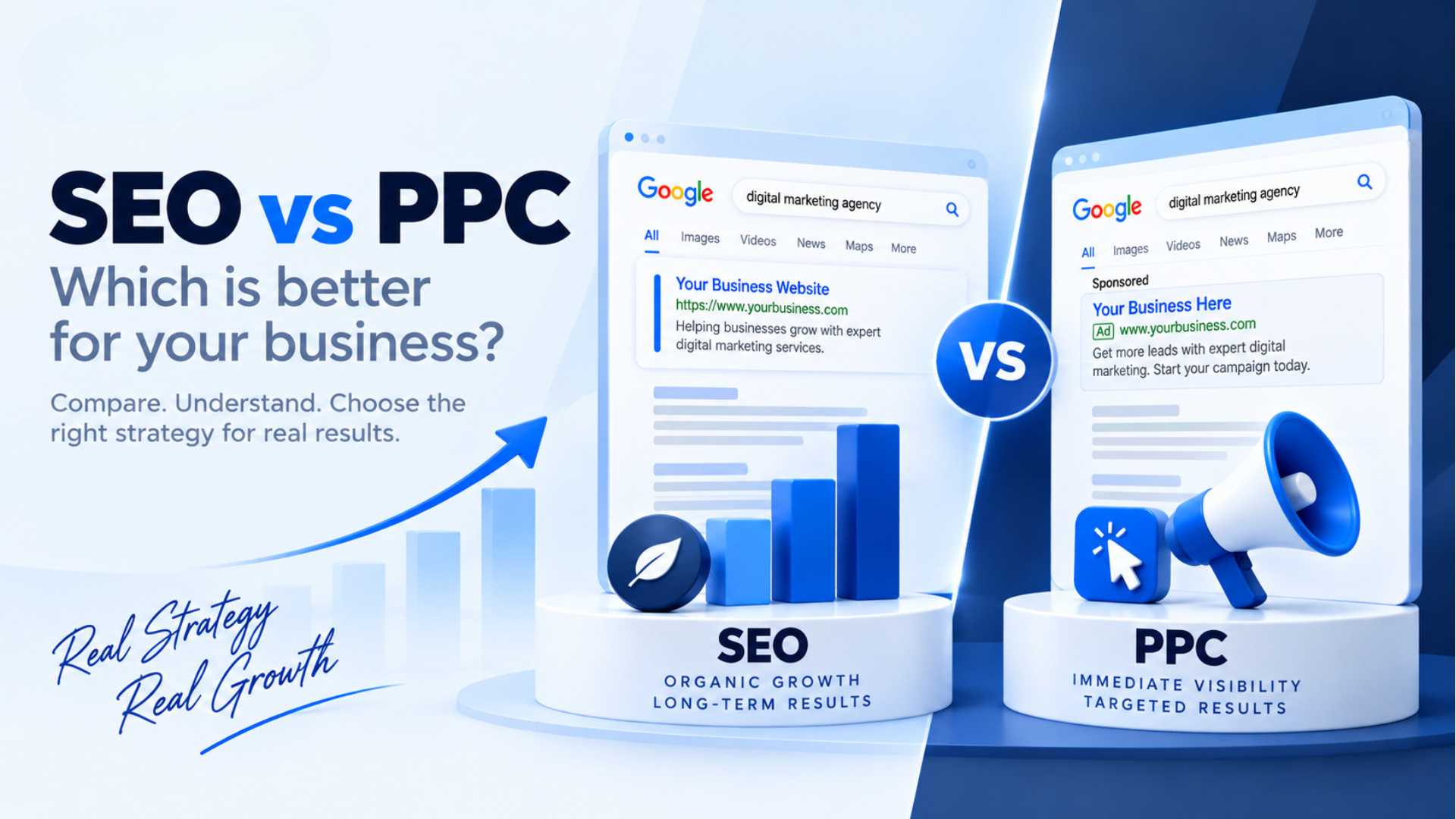
Our SEO vs PPC guide compares the strengths, limitations, costs, and timelines of both approaches.
If paid advertising becomes part of the plan, you can also review our guide to Google Ads cost in the UK to understand CPC, budgets, and campaign economics.
This is a more natural decision than asking an SEO provider to somehow make organic search behave like paid advertising.
SEO agency vs freelancer: Which should you choose?
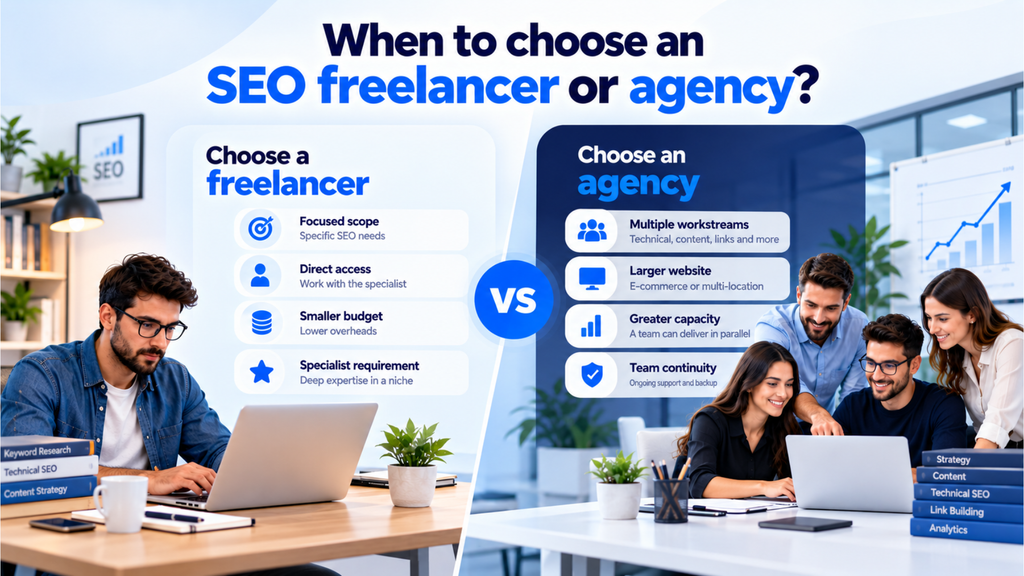
Choose a freelancer when you value direct access, specialist expertise, flexibility, and a focused scope that one experienced person can realistically manage. Choose an agency when your campaign requires broader expertise, several workstreams, greater delivery capacity, formal processes, or continuity across a team.
The decision should not be based on the assumption that agencies are automatically more professional or that freelancers are automatically better value. Look at the people, experience, process, capacity, communication, and work required.
A strong provider in the right delivery model will usually outperform a theoretically “better” model that does not fit your business.
Frequently asked questions
Is an SEO agency better than a freelancer?
Not automatically. An agency usually offers broader expertise, greater capacity, and team continuity, while a freelancer can provide direct access, flexibility, and specialist expertise at a lower overhead. The better option depends on your website complexity, internal resources, budget, and required scope.
Is an SEO freelancer cheaper than an agency?
Freelancers are generally cheaper because they have fewer operational overheads, although experienced consultants can still charge premium rates. Compare the actual expertise, time, deliverables, and outcomes included in each proposal instead of choosing solely by monthly price.
Can a freelancer handle a complete SEO campaign?
Yes, particularly for small and medium-sized websites or campaigns with a focused scope. However, campaigns requiring substantial technical work, content production, digital PR, outreach, development, and analytics simultaneously may exceed one person’s capacity unless they work with additional specialists.
When should I hire an SEO agency?
An agency makes sense when the campaign requires multiple specialists, significant ongoing output, formal project management, greater continuity, or the capacity to scale quickly. It can also be suitable for larger organizations with multiple stakeholders and complex websites.
How do I know whether an SEO provider is trustworthy?
Ask for examples of previous work, references, clear explanations of their methods, realistic expectations, and transparent reporting. Avoid providers guaranteeing number-one rankings or refusing to explain what they plan to change. Google recommends interviewing potential SEOs and checking references before giving them significant website access.